


Networking in the public Amazon Web Service (AWS) cloud is about to get a lot easier and faster.
There are multiple ways that organizations connect to and across the AWS cloud network, with the Amazon Virtual Private Cloud (VPC) among the most popular. With a VPC, an organization is able to isolate their use of AWS services to a specific virtual network segment.
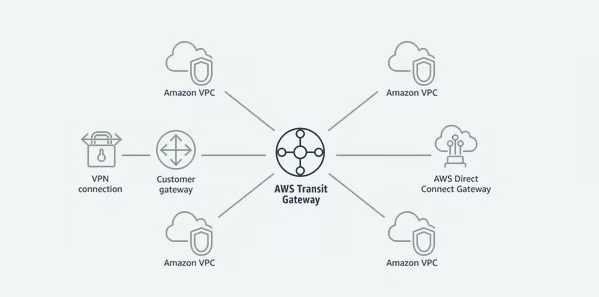
Networking within different AWS VPCs can be a somewhat complex challenge, which the new AWS Transit Gateway, announced during the 2018 AWS:reinvent conference, is looking to solve. The basic idea behind the AWS Transit Gateway is that it enables a traditional hub-and-spoke network topology across virtual resources in the cloud.
“You can connect your existing VPCs, data centers, remote offices, and remote gateways to a managed Transit Gateway, with full control over network routing and security, even if your VPCs, Active Directories, shared services, and other resources span multiple AWS accounts,” AWS Chief Evangelist Jeff Barr said.
So rather than requiring multiple set of tools, accounts and policies to connect into different VPCs, an organization can consolidate edge connectivity and route everything via a Transit Gateway.
Each Transit Gateway can support up to 5000 VPCs, and up to 50 Gbps of data traffic.
Global Accelerator
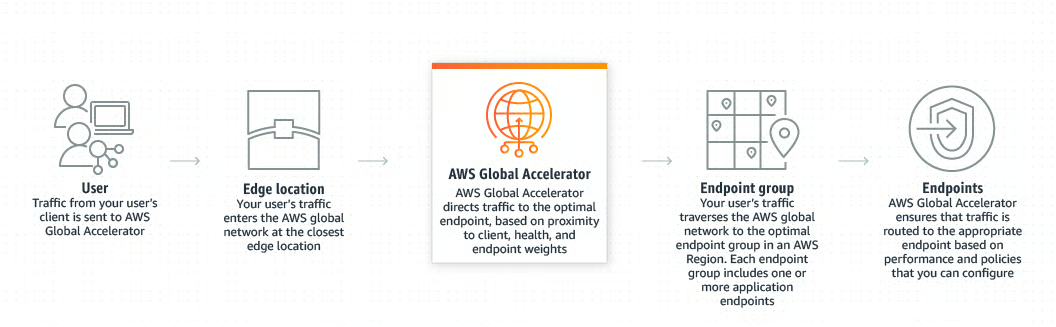
Getting to all the different network segments in an AWS deployment can sometimes be impacted by latency from end users and other network performance issues. The new AWS Global Accelerator, also announced at re:invent, is just that, a network acceleration platform.
“With AWS Global Accelerator, your users are directed to your application based on geographic location, application health, and routing policies that you can configure,” AWS stated in a media advisory. “AWS Global Accelerator also allocates static anycast IP addresses that are globally unique for your application and do not change, thus removing the need to update clients as your application scales.”
Global Accelerator is a planetary scale load balancing system for applications, but it is different than AWS’ existing Elastic Load Balancing (ELB) platform. In fact, AWS recommends that organizations use the Global Accelerator alongside ELB.
“AWS Global Accelerator relies on ELB to provide the traditional load balancing features such as support for internal and non-AWS endpoints, pre-warming, and Layer 7 routing,” an AWS FAQ on Global Accelerator said. “While ELB provides intra-region load balancing, AWS Global Accelerator provides inter-region traffic management.”
Sean Michael Kerner is a senior editor at EnterpriseNetworkingPlanet and InternetNews.com. Follow him on Twitter @TechJournalist.